
Your Team Hits Every Sprint Goal and Nothing Moves Forward
Making weekly check-ins lightweight, informative and less time consuming.

Most teams set OKRs once a quarter and forget about them until the review meeting. By then it is too late to change anything.
The problem is rarely the OKRs themselves. It is how teams track progress. Check-ins feel like paperwork. Updates happen in spreadsheets nobody opens. By the time someone notices a key result is off track, the quarter is almost over.
I have seen this across organisations at every stage of OKR maturity. The pattern is the same: teams struggle to track progress in a way that is lightweight enough to actually stick.
Here are three rules that help.
Rule 1: Avoid Spreadsheets
Using spreadsheets to track OKRs may seem like a simple and cost-effective solution, but it comes with pitfalls. Clear progress and visuals are also the strengths of OKRs, and while you might be tempted to start with spreadsheets, this may not be the best visualization option, potentially decreasing the overall engagement with the framework.
Collaborating with spreadsheets does happen, but maintaining historical data can be tough. Quite often, you end up reusing the same cells and overwriting old data.
I'd recommend trying something like Asana, Workpath, Profit, or Tability.
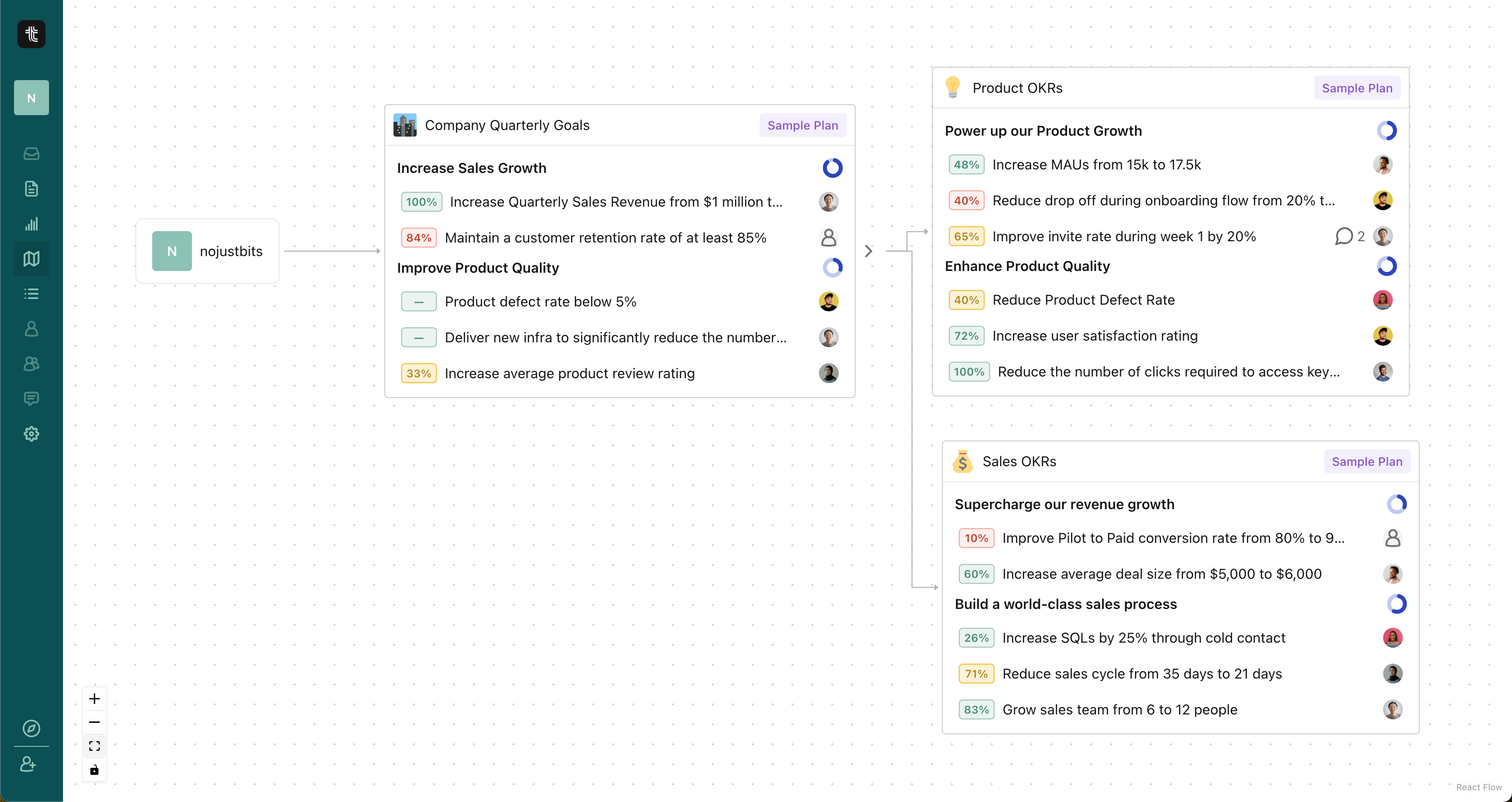
Rule 2: Reduce Manual Data Entry
By directly extracting the necessary information for updating progress, the tools I discussed earlier can save you time and effort. They offer integrations with popular data sources such as Hubspot, Jira, Asana, or your databases. This means you can concentrate your weekly check-in call on topics of importance.
Minimizing manual data entry not only cuts time spent on updating OKRs but also, through integrations with Microsoft Teams or Slack, enables you to automatically inform stakeholders when check-ins are complete, or to request additional manual input when fully automated scoring is not achievable.

Rule 3: Standardise Reporting
Formulate standard templates for OKR check-ins to ensure consistency and smooth the reporting process. This step reduces the effort needed to manually format and structure information. For measurable Key Results, establish a consistent method of calculating progress. For example, the below formula can be used to calculate the percentage of progression relative to the initial value of your metric for a Key Result (KR):

Furthermore, to provide a more context-based evaluation of calculated progress and the remaining time until the end of the quarter, you can assign the following confidence levels:
🔴 Off Track: Shows that progress is less than expected, and action is needed.
🟡 At Risk: Indicates the Key Result is at risk and might need extra monitoring and changes to get back on course.
🟢 On Track: Confirms the Key Result is progressing well towards the target.
For me, having a clear, intuitive understanding of the current situation of projects is key. If you prefer, you can also use a numerical confidence level, much like the example below.

Conclusion
The point is not to make OKR tracking perfect. It is to make it cheap enough that people actually do it.
If check-ins feel like admin, your team will avoid them. If progress is visible without effort, conversations shift from “where are we” to “what do we do about it.”
Pick a tool that connects to your existing data. Agree on one way to score progress. Run the check-in in 15 minutes. That is it.
The goal is not better tracking. It is better decisions, faster.